Mobile Laser Tag with Inflatable Arenas: A Scalable Business Model for Events
A mobile format in event entertainment is no longer an experiment. It is a working commercial model with predictable economics, fast deployment, and clear demand across private and corporate segments.
Mobile laser tag with inflatable arenas fits into this logic precisely. It is not about equipment rental. It is about running events as a service – with control over the format, pricing, and client experience.
At its core, this model removes the main constraint of traditional entertainment businesses: location dependency.
What Is a Mobile Laser Tag Business?
The mobile laser tag business is built around on-site events. The operator does not wait for customers to arrive – the service is provided directly to the customer.
This includes private properties, schools, parks, corporate premises, or temporary event venues.
In practice, mobile laser tag with inflatable arenas means you can deploy a full-fledged playing field almost anywhere. No construction. No permits tied to a fixed location. No long installation cycles.
The operator sells time-based sessions, not access to the venue.
How the Mobile Event Model Works
The process is straightforward, although execution quality defines margins.
Step 1: Customer Orders the Game
A client books an event – typically a birthday, corporate activity, or team session. Duration usually ranges from 2 to 4 hours.
Step 2: Equipment Delivery
The operator transports the full kit: laser tag gear, inflatable bunkers, and control systems.
Step 3: Arena Setup with AIRBUNKER
The field is assembled on-site. Depending on the scale, setup takes 30–60 minutes.
Step 4: Running the Event
The operator develops game scenarios. Once completed, the equipment is packed and moved to the next location.
Simple on paper. Profitable in practice – if logistics and turnover are handled correctly.
Why Mobile Laser Tag Is a Scalable Event Business
The key advantage lies in replication and positioning as a low startup cost business.
A scalable event business does not depend on a single location or fixed capacity. Instead, it grows through the number of events executed per week.
This model allows:
- parallel bookings across different locations
- expansion by adding identical equipment sets
- predictable revenue per session
The event entertainment business model here is based on turnover rather than foot traffic.
That distinction matters.
Key Advantages of Mobile Event Entertainment
Mobile entertainment events change the cost structure and operational logic.
- No space rental or long-term lease
- Flexible pricing depending on the type of client
- Possibility of working in different cities or regions
- Direct access to private and corporate clients
- Lower entry threshold compared to stationary venues
For many operators, party entertainment services become the entry point. Later, corporate contracts and regular events became the main source of income.
AIRBUNKER: Inflatable Arenas as a Business Tool
Inflatable infrastructure is not just a visual element. It directly affects speed, scalability, and pricing.
Air-bunkers are designed specifically for commercial use, where equipment must withstand constant transport and repeated deployment.
What Is AIRBUNKER
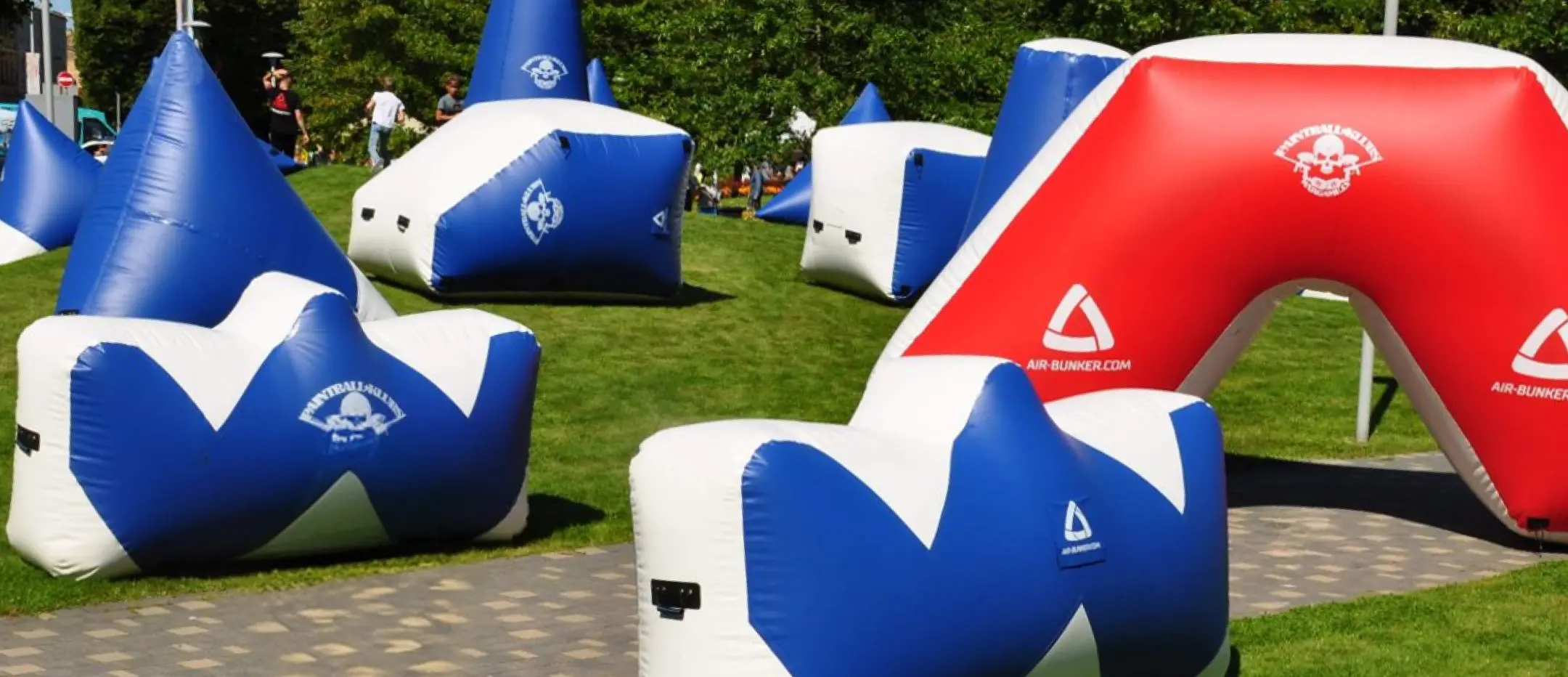
AIRBUNKER is NETRONIC’s line of inflatable bunkers designed for tactical and entertainment operations. It allows operators to quickly build a physical arena either at their own venue or directly at the client’s location, providing flexibility for both permanent and mobile setups.
This is equipment for businesses that sell events, not just gear. The point is simple: faster setup, lower overhead, and a field that can work in parks, schools, corporate spaces, and other temporary locations.
Core Technical Features
The construction is based on 0.55 mm PVC tarpaulin with reinforced seams and load-bearing elements.
In operational terms, this means:
- resistance to frequent setup cycles
- tolerance to weather conditions
- simplified cleaning and storage
Types of Inflatable Arenas
Different configurations support different business scenarios.
- Sports layouts for tournaments and large-scale events
- Tactical schemes for scenario games
- Drone racing elements for additional monetization formats
Branding and Customization
Visual identity plays a role in the corporate segment.
Custom colors and logos allow the arena to serve as part of the event branding, thereby increasing perceived value and supporting higher pricing.
Equipment Required to Launch a Mobile Laser Tag Business
A complete setup includes more than markers and vests.
Typical configuration:
- laser tag units (10–20 players)
- headbands and control modules
- scenario management system
- inflatable bunkers (basic or extended set)
- transport and repair kits
In practice, the operator buys a working system, not separate components.
Startup Costs and Investment Breakdown
From a financial standpoint, this falls into the low startup cost business category compared to location-based entertainment.
- Entry level: around 14,000 USD
- With inflatable arenas: approximately 19,000 USD
The difference is not cosmetic. Inflatable air-bunkers directly impact pricing and event perception.
Revenue Model and Profitability
Revenue is tied to event duration and group size.
Average Check per Event
A typical 3-hour session for 10–12 players generates 300–900 USD.
Inflatable arenas increase this by 20–40% due to perceived scale and structure.
Payback Period
Based on operator data, payback averages around 9 months.
In some cases – faster, depending on booking density.
ROI Drivers
- high frequency of events
- minimal fixed costs
- reuse of the same equipment
- upselling extended scenarios and larger fields
There is no single “magic factor”. Profitability comes from a consistent load.
Logistics: Transport, Setup, and Operations
Mobility defines efficiency.
A full set of inflatable bunkers and equipment fits into a standard vehicle. For example:
- sedan class – one field
- SUV – two fields
- pickup – extended configurations
Setup is handled by a small team. In many cases – two people are enough.
Time matters here. Faster deployment means more bookings per day.
Scaling the Business: From Solo Operator to Network
Growth follows a simple path.
First – one kit, local market, weekend bookings.
Then – additional sets, parallel events, broader geography.
Eventually, operators build networks covering multiple cities or regions.
The scalable event business logic remains unchanged. Only volume increases.
Use Cases: Who Orders Mobile Laser Tag Events
Demand is diversified, reducing dependence on a single segment.
- private clients (children’s parties, birthdays)
- corporate teams (team building, HR events)
- schools and camps
- outdoor festivals and public events
Each segment has its own pricing logic and expectations.
Integration with Existing Event or Entertainment Businesses
For existing operators, this is not a replacement. It is an extension.
Laser tag arenas, paintball clubs, event agencies – all can add a mobile format.
This allows:
- handling overflow demand
- entering new markets without new locations
- increasing equipment utilization
In other words, one operational system generates multiple revenue streams.
FAQ
How much investment is required to start?
Around 14,000 USD for a basic setup, or about 19,000 USD if inflatable arenas are included.
What is the typical payback period?
On average, around 9 months, depending on event frequency and pricing.
How much can one event generate?
A standard session brings 300–900 USD, with higher checks when inflatable arenas are used.
How long does one event take?
2–4 hours for gameplay, plus about 1 hour for setup and dismantling.
Who are the main clients?
Private customers, corporate teams, schools, and event organizers.